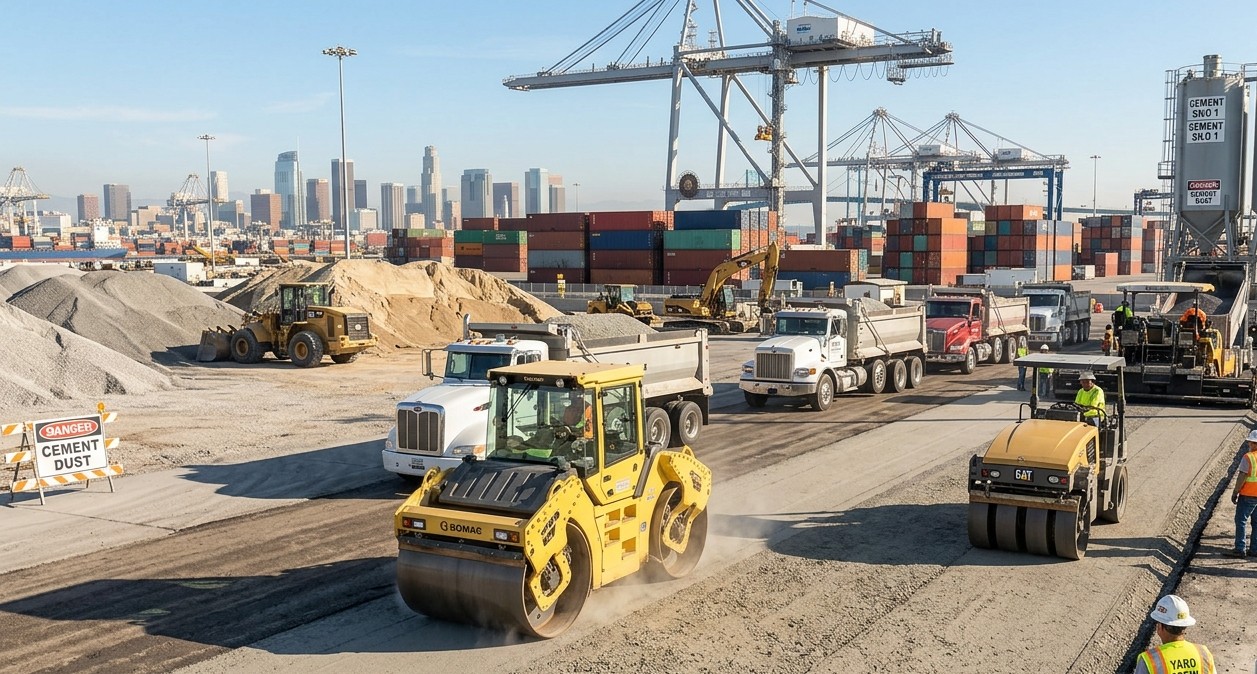
Roller Compacted Concrete Los Angeles
If you’re responsible for a commercial, industrial, or municipal property here in Southern California, you know one thing: Los Angeles pavement earns its keep. With heavy traffic, delivery trucks and sweltering summers, traditional paving materials just don’t cut it. That’s where Roller Compacted Concrete (RCC) projects are getting a lot of attention.
RCC is an economical, sustainable substitute for traditional concrete and asphalt surfaces, particularly for heavy-use areas.
What Is Roller Compacted Concrete?
Roller compacted concrete is a no-slump concrete placed with asphalt paving equipment and then compacted with rollers. Though it’s made of the same basic ingredients as traditional concrete (cement, aggregates and water), the mix is much lower in water content, resulting in a stiffer product with a gritty texture.
This means that RCC can be placed faster, without the use of forms and minimal to no finishing.
Why Roller Compacted Concrete is Best for LA
Pavement conditions in Southern Californian are different than elsewhere. From strong sun nearly all year long to heavy commercial use, pavement needs to be able to take a beating.
Designed for Heavy Loads
RCC performs exceptionally well under:
-
Truck traffic and freight movement
-
Warehouse forklifts and container storage
-
Bus lanes and service roads
RCC is popular with many industrial paving projects in Los Angeles because it can withstand rutting, potholes, and surface deformation much better than asphalt.
Faster Installation, Less Disruption
Another major advantage of roller compacted concrete is speed. RCC can typically be placed and compacted in a single day, and opened to traffic sooner than conventional concrete — sometimes as soon as 24 hours.
That quick turnaround can be crucial for logistics hubs, retail centers and municipal facilities.
Typical Uses for RCC in Los Angeles
RCC is particularly well-suited to high-impact locations throughout LA County, including:
-
Industrial yards and distribution centers
-
Commercial parking lots
-
Port and freight facilities
-
Bus depots and transit corridors
-
Utility roads and access lanes
In places such as Vernon, Commerce and the South Bay (where heavy trucking is in perpetual motion), RCC pavement often provides a longer life span with lower maintenance costs.
Roller Compacted Concrete vs. Asphalt
Property owners frequently wonder if RCC is worth the trade-off with asphalt. The answer is…sometimes.
When you choose asphalt, you’re looking at:
-
Lower upfront cost
-
Faster initial installation
-
Regular maintenance
With RCC, you have:
-
Higher strength and load capacity
-
Improved resistance to heat and oils spills
-
Lower maintenance costs
For infrastructure that will see repeated heavy use for years to come, RCC is often ultimately the most cost effective solution.
Environmental and Heat Benefits
The lighter color of RCC reflects more sunlight than asphalt, contributing to lower surface temperatures, which means it doesn’t add as much to L.A.’s urban heat environment. This helps create better conditions and reach sustainability in any commercial project.
What’s more, a good number of RCC formulations include a proportion of supplementary cementitious materials that can reduce the overall environmental impact without comprising performance.
Key Considerations Before Choosing RCC
Although RCC comes with a lot of advantages, there are pitfalls you should be aware of:
-
Surface texture is rougher than a standard concrete block.
-
The decorative look is not great, making it not ideal for home use.
-
Needs seasoned contractors to correctly compact and cure the concrete
This is why hiring a paver that understands roller compacted concrete in Los Angeles is important for the long-term.
Tips for Los Angeles Property Owners
If you’re thinking about using RCC:
-
Think about using RCC for assess traffic loads; RCC is an open standout in high-wear conditions
-
Carefully plan for drainage: adequate slope and a good base are the most important factors
-
Inquire about lifecycle costs, not just upfront pricing
-
Verify curing procedures, as they are critical for strength and durability
When properly designed, an RCC pavement can last for decades without any intervention.
For commercial, industrial and municipal facilities that need to be up and running all the time without constant repairs, RCC provides long-term value that traditional materials can't match.
Ready for your consultation to find out if RCC is the right fit for your project? Give us a call today for a free estimate.