Types of Concrete Curbs: A Complete Guide for Los Angeles Properties
Concrete curbs may be a small detail, but in a city like Los Angeles, they have big implications. From traffic control and training to curb appeal, these are the hard workers of your property. Whether selecting a curbing that can withstand the abuse of commercial parking lots or one for a home landscape job, choosing the right curb for your property is an important construction choice.
Why Los Angeles Cares About Concrete Curbs
Los Angeles properties come with their own challenges: traffic, municipal codes, steep stormwater runoff requirements and the wear and tear of perpetual sunlight. Concrete curbs help:
-
Confine pavement edges and direct the movement of vehicles
-
Improve pedestrian and driver safety
-
Drain water to promote flow during heavy rain
-
Add beauty to your streets and parking lots.
The right curb is important for far more than appearance. It’s also about function, compliance and longevity.
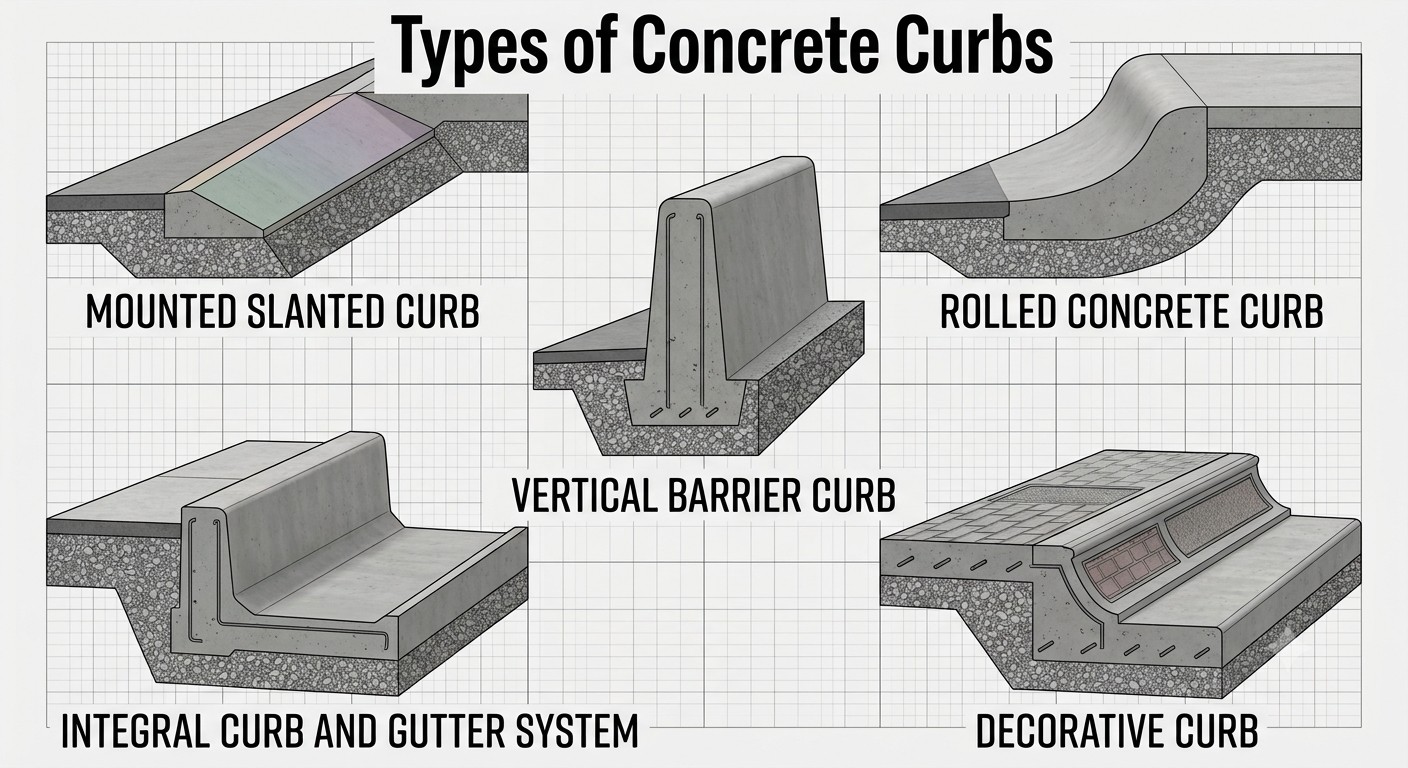
Vertical Barrier Concrete Curbs
Vertical barrier concrete curbs are ideal for roads with heavy traffic, business parking lots, and industrial areas.
Vertical concrete curbs, also known as barrier curbs, have a vertical or nearly vertical face. These are some of the most common curbs used in LA because they offer strength and efficiency.
Key benefits:
-
Keep vehicles on the roadways and off other obstructions.
-
Define driving and parking areas clearly
-
Durable enough for constant traffic
Vertical curbs are the types of curbs you see on city streets, shopping centers, commercial developments and other such properties across LA.
Rolled Concrete Curbs
Rolled concrete curbs are best for residential neighborhoods, side streets, driveways.
Rolled concrete curbs have a rounded top or scalloped shape that can be driven over very slowly. You usually find them in residential developments and suburban areas in Los Angeles County.
What home owners like about rolled curbs:
-
Easier vehicle access
-
Less aggressive look than barrier curbs
-
Great in neighborhoods with frequent driveway crossings.
These curves strike a more rounded character being both functional but non-authoritative, and an ideal option for residential areas.
Mountable Slanted Concrete Curbs
Mountable slanted concrete curbs are great for parking lot entrances, and emergency access areas.
Mountable concrete curbs have an angled face to offer controlled vehicle access. They are purposeful openings, not rolled curbs.
Common uses in Los Angeles:
-
Commercial parking lot entrances
-
Fire lane access points
-
Service vehicle routes
Mountable slanted concrete curbs ease traffic flow without simply dictating movement, which is important in densely packed urban layouts.
Integral Curb and Gutter Systems
Highly durable integral curb and gutter systems are ideal for streets, roads and stormwater control.
What are integral curb and gutter systems? These are structures in which the curb and six to 12 inches of cutter are poured together as one structure. This feature is very common in LA street design, and it helps in draining water faster.
Advantages include:
-
Directs stormwater toward drains
-
Reduces erosion and standing water
-
Long-lasting, low-maintenance solution
Because of the strict stormwater requirements for LA, in-line curb and gutters are frequently specified on municipal and large-scale construction projects.
Decorative and Custom Concrete Curbs
Decorative and custom concrete curbs are best for retail centers, homeowners’ associations, and commercial properties.
Decorative concrete curbing is used to add a splash of color and provide durable landscape edging. These curbs can be colored, stamped or textured to coordinate with the outdoor environment.
Why they’re popular in Los Angeles:
-
Improved curb appeal
-
Reinforced brand or property identity
Decorative and custom concrete curbs are often found at shopping centers, office parks and residential communities where how they look is as important as what they do.
How to Select the Right Kind of Concrete Curb
When it comes to choosing from amongst all the various types of concrete curbs, Los Angeles property owners should take into account:
-
Volume of traffic: The greater the amount of traffic, the stronger a barrier-style curb will need to be.
-
Drainage requirements: When directing stormwater flow, an integrated curb and gutter does the trick
-
Accessibility: Ramped or mountable curbs best for vehicle crossing
-
Local codes: Some jurisdictions have mandated curb styles
-
Aesthetics: Decorative options enhance property value
Using a skilled local contractor is the best way to ensure that the design of your curb matches your functional needs and is acceptable to city standards.
Los Angeles Concrete Curb Installation
Professional curb installation typically includes:
-
Site evaluation and layout planning
-
Subgrade preparation
-
Forming and reinforcement
-
Concrete placement and finishing
-
Proper curing for long-term strength
Knowing the different types of concrete curbs assist Los Angeles home and business owners in making choices that are best for safety, draining, and aesthetic appeal. Whether you have a new project or are looking to renovate an existing structure, selecting the right curb type is essential for long-term function and to adhere to local regulations.